This post contains affiliate links. As an Amazon Associate we earn from qualifying purchases, at no extra cost to you. Read our disclosure.
Safety first: Herbs can be powerful. If you are pregnant, nursing, take medication or have a health condition, check with your doctor or pharmacist first. Please read our herbal & garden safety notes before you start.
Key takeaways
- Four enemies: light, air, heat and moisture. Airtight and dark covers two of them; keeping jars away from the stove covers a third.
- Amber jars block light, clear jars don't. Clear glass is fine inside a cupboard or drawer; on an open shelf, choose amber or tins.
- Store whole, crush when you cook. Whole leaves hold aroma two to three times longer than crushed ones.
- Shelf life is a range, not a date. Most leafy herbs stay good for about 1 to 3 years; check by smell and color, not the calendar.
- Label with name, date and whole or crushed. A jar you can't identify in March is a jar you won't use.
In this post27 sections
- What dried herbs need from storage (and how we judged each idea)
- Amber jars vs clear jars vs tins: an honest comparison
- Dried herb storage jars (5 ideas)
- 1. Amber glass jar set with gasket lids
- 2. Clear mason jars in a dark cupboard
- 3. Swing-top jars with rubber gaskets
- 4. Mini 2 oz jars for small batches
- 5. A working set of clear shaker jars in a drawer
- Dried herb storage containers that aren't jars
- 6. Metal tins with tight-fitting lids
- 7. Resealable mylar pouches for overflow
- 8. Vacuum-seal canister or vacuum lids
- 9. A freezer jar for soft herbs and big batches
- Racks, risers and drawer inserts for a tiny kitchen
- 10. Tiered riser inside a cupboard
- 11. Drawer insert with jars lying flat
- 12. Narrow wall rack on an interior wall, away from the stove
- 13. Over-the-door pantry rack
- 14. Tabletop apothecary drawer cabinet
- Labels that work: name, date and whole or crushed
- 15. A label system: kraft labels on the front, dates on the lid
- Where to put it all: dark cupboard, drawer or open shelf
- How long dried herbs last (leaves, seeds, roots, blends) and how to check
- Storing whole vs crushed, and freezing herbs you dried too late
- Dried herb storage mistakes that waste a harvest
- A small-kitchen dried herb storage starter list
- FAQ
What dried herbs need from storage (and how we judged each idea)
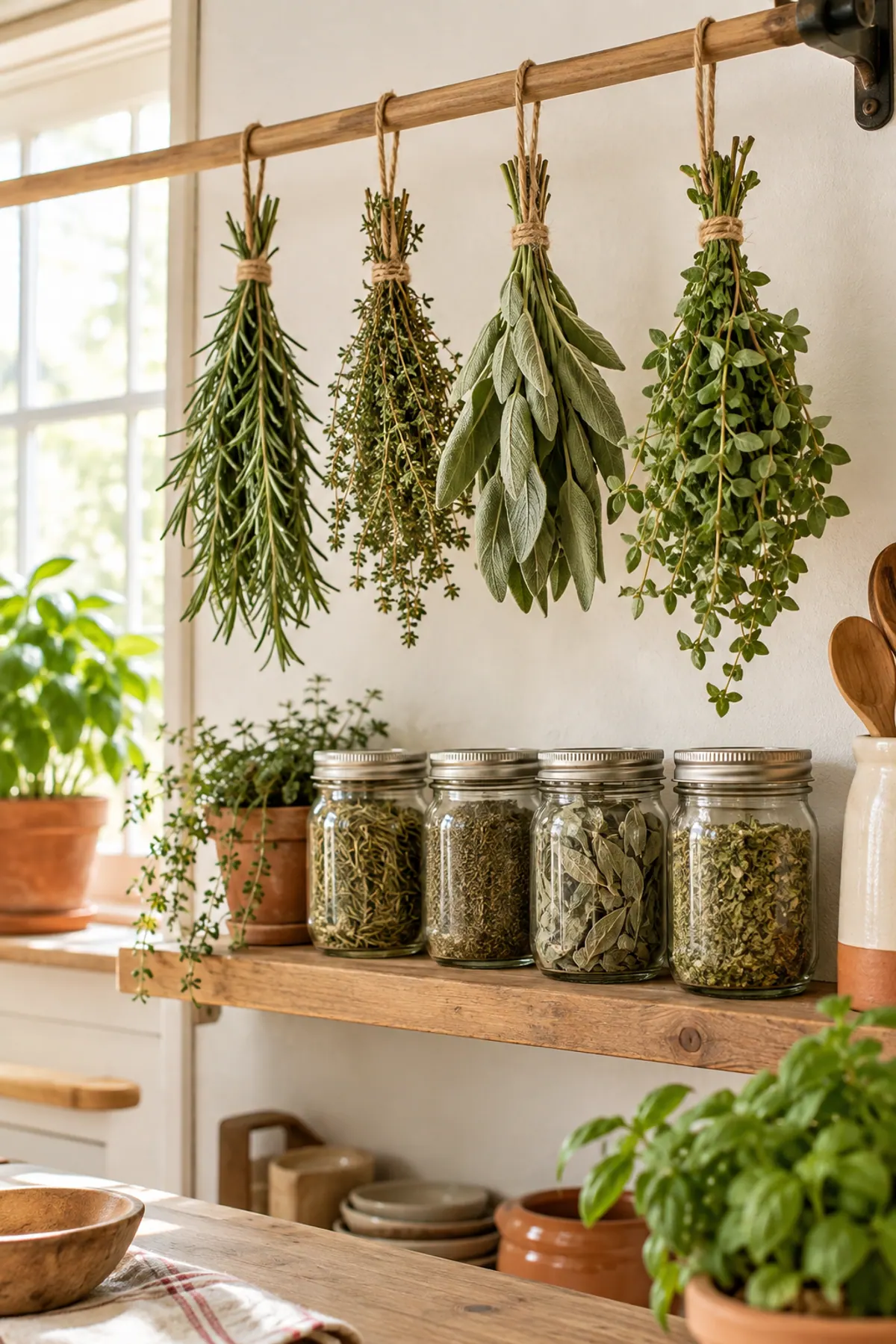
Dried herbs lose flavor to four things: light fades color and the oils that carry aroma, air oxidizes those oils, heat speeds both up, and moisture lets mold in. Good dried herb storage blocks as many of the four as your kitchen allows. This article covers storage only; for how to dry herbs in the first place, see how to dry herbs at home.
Each idea below carries three tags. Light-proof means the container itself blocks light. Airtight means a real seal, not a shaker lid. Counter-safe means it can live out in the open on a counter or shelf without losing flavor fast. Then one line says what that setup does to flavor over a year.
We have not tested these products by hand. The picks are judged on the four enemies above, on size for a small kitchen, and on honest price ranges, which change often.
Amber jars vs clear jars vs tins: an honest comparison
Amber glass filters most of the UV light that fades herbs, which is why pharmacies and spice shops use it. But a clear jar inside a dark cupboard is just as dark as an amber jar on a shelf. Tins block all light and most are not fully airtight. Here is how the three compare.
| Container | Light | Air seal | Best spot | Flavor over a year |
|---|---|---|---|---|
| Amber glass jar, screw or gasket lid | Blocks most UV | Good to excellent | Open shelf or cupboard | Holds well in either spot |
| Clear glass jar, screw or gasket lid | None | Good to excellent | Dark cupboard or drawer only | Holds well in the dark; fades in months on a sunny shelf |
| Clear jar with shaker lid | None | Poor | Not for long-term storage | Fastest loss; fine for the week's herbs |
| Metal tin, slip lid | Blocks all light | Fair; most leak a little air | Shelf, counter or drawer | Good for 6 to 12 months; use for herbs you go through fast |
| Metal tin with gasket or screw lid | Blocks all light | Good | Anywhere, including by the stove wall | Holds well; the best counter choice |
| Mylar or foil pouch, zip seal | Blocks all light | Good when squeezed flat | Drawer or box | Holds well; best for big batches and overflow |
Glass or plastic? Glass, or metal. Plastic takes on smells, scratches and lets a little air through over time. The one exception is a thick zip pouch for overflow, which is sealed and dark.
If your herbs come from pots on a windowsill, our free planner has a one-page herb cheat sheet with harvest and drying timing, which pairs with the shelf-life table further down.
Dried herb storage jars (5 ideas)
Pinterest searches for dried herb storage lead with containers and jars, so we start there. Glass is the standard for a reason: it seals tightly, washes clean and never takes on last year's oregano.
1Amber glass jar set with gasket lids
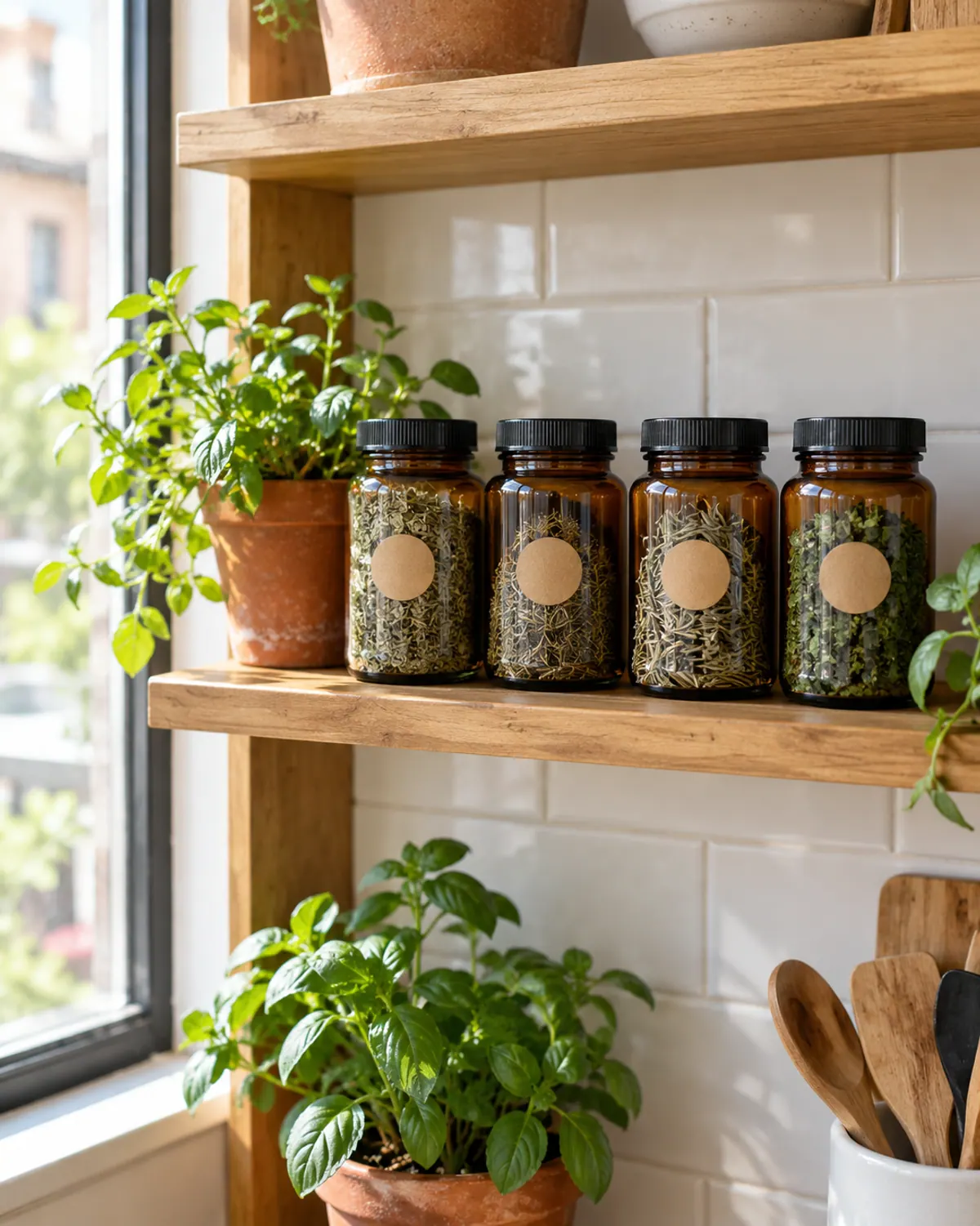
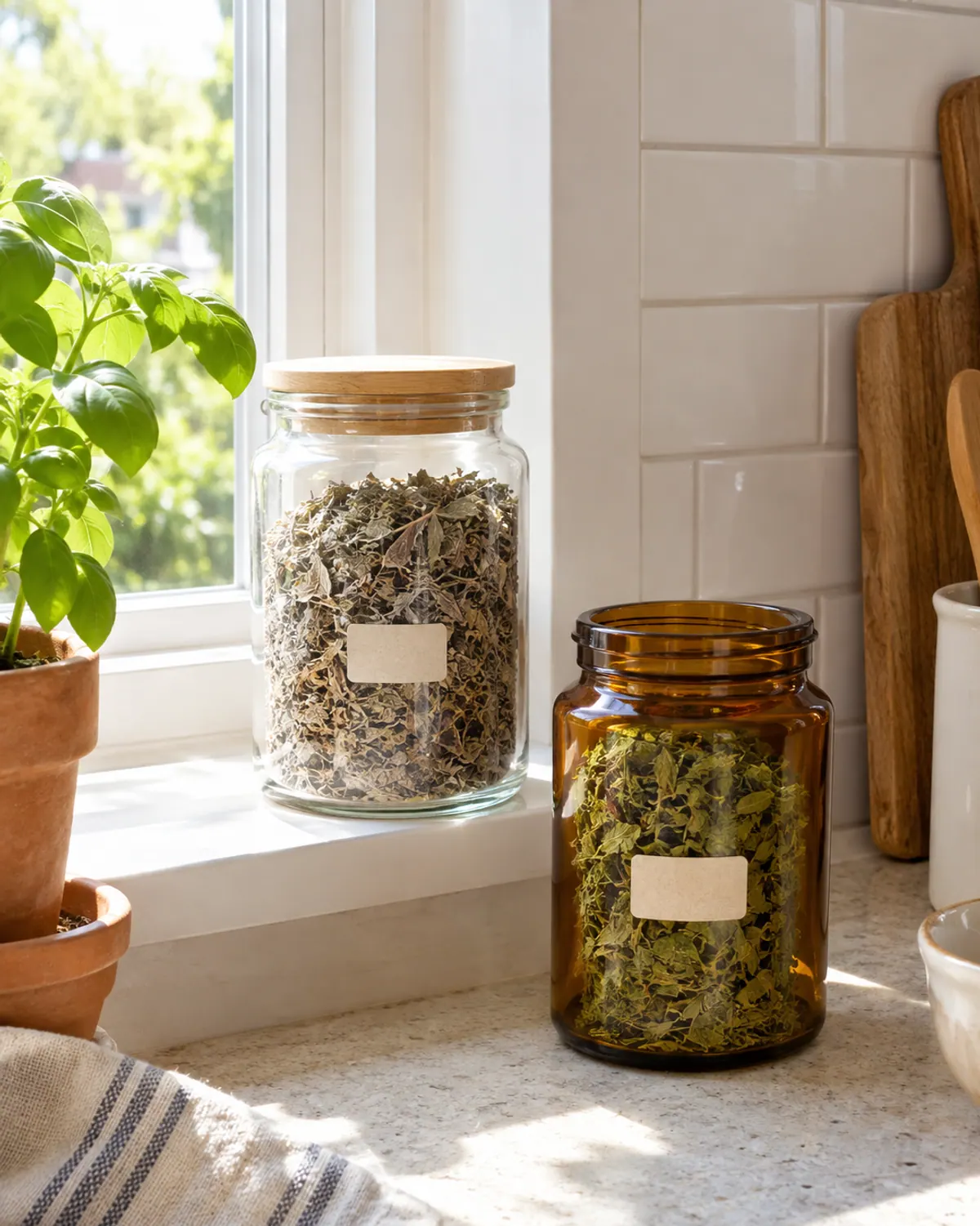
Light-proof: yes. Airtight: yes. Counter-safe: yes. The all-rounder. Amber glass filters most UV, and a screw or gasket lid keeps air out, so these can sit on an open shelf next to the window without fading. Flavor: whole leaves stay close to full aroma well into the second year.
Buy a set in 4 oz for everyday herbs and a few 8 oz for the ones you grow most (oregano, mint, thyme). Skip sets that only come with shaker lids; you want a solid lid under any shaker insert.
- The amber tint makes it hard to see how much is left, so label the front with the herb name and the lid with the date.
Blocks light and seals; the one set that works on a shelf or in a cupboard.
2Clear mason jars in a dark cupboard
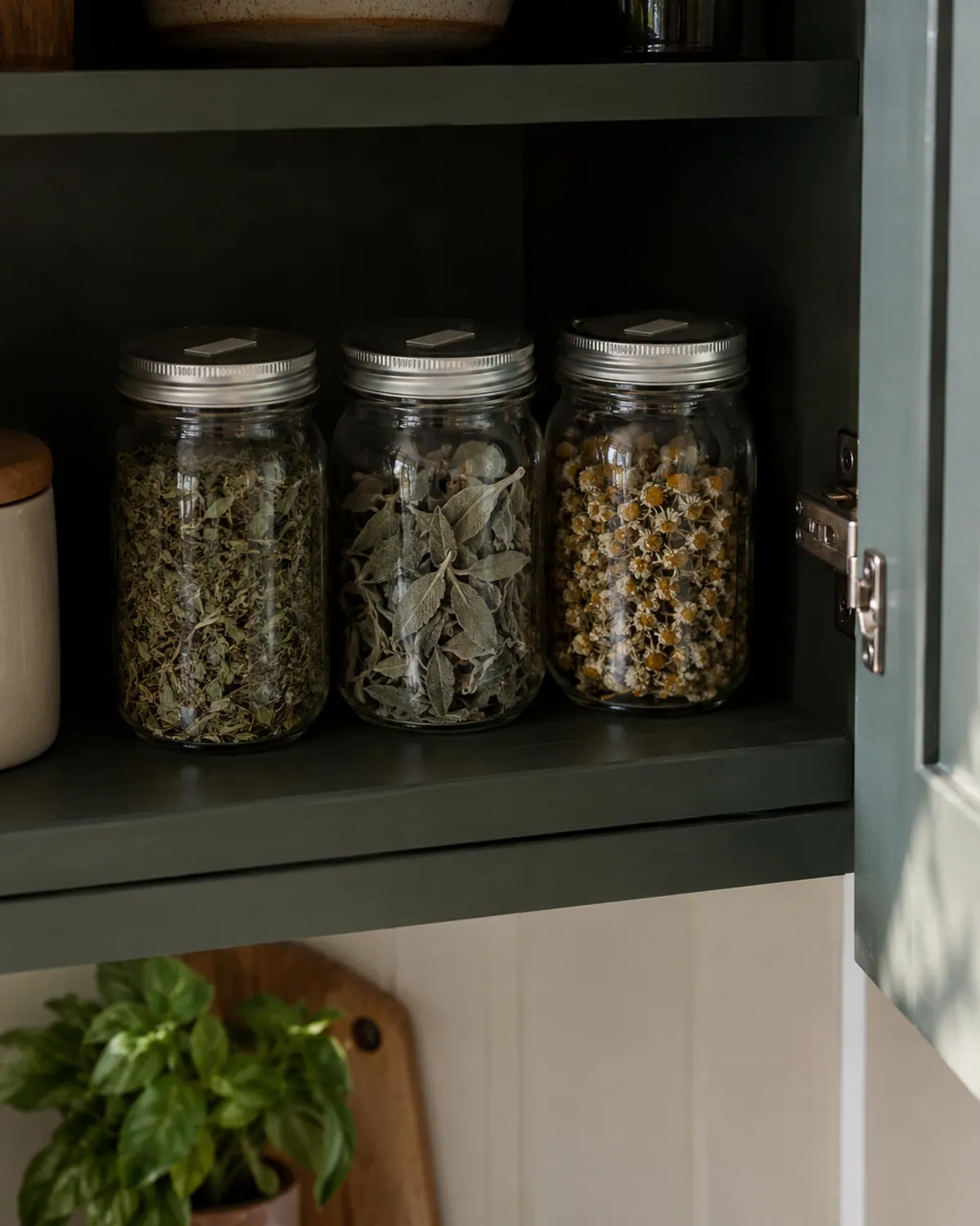
Light-proof: no (the cupboard does that). Airtight: yes. Counter-safe: no. The cheapest airtight storage there is, and if you already can, you own them. A two-piece canning lid or a one-piece storage lid seals well. Flavor: holds as well as amber glass, as long as the door stays closed.
Use half-pints for most herbs; a full pint of dried oregano is more than a small household uses in a year, and every opening lets air in.
- Keep the cupboard away from the stove and dishwasher; heat on the wall behind matters even with the door shut.
Cheapest sealed glass you can buy, and the sizes stack.
3Swing-top jars with rubber gaskets
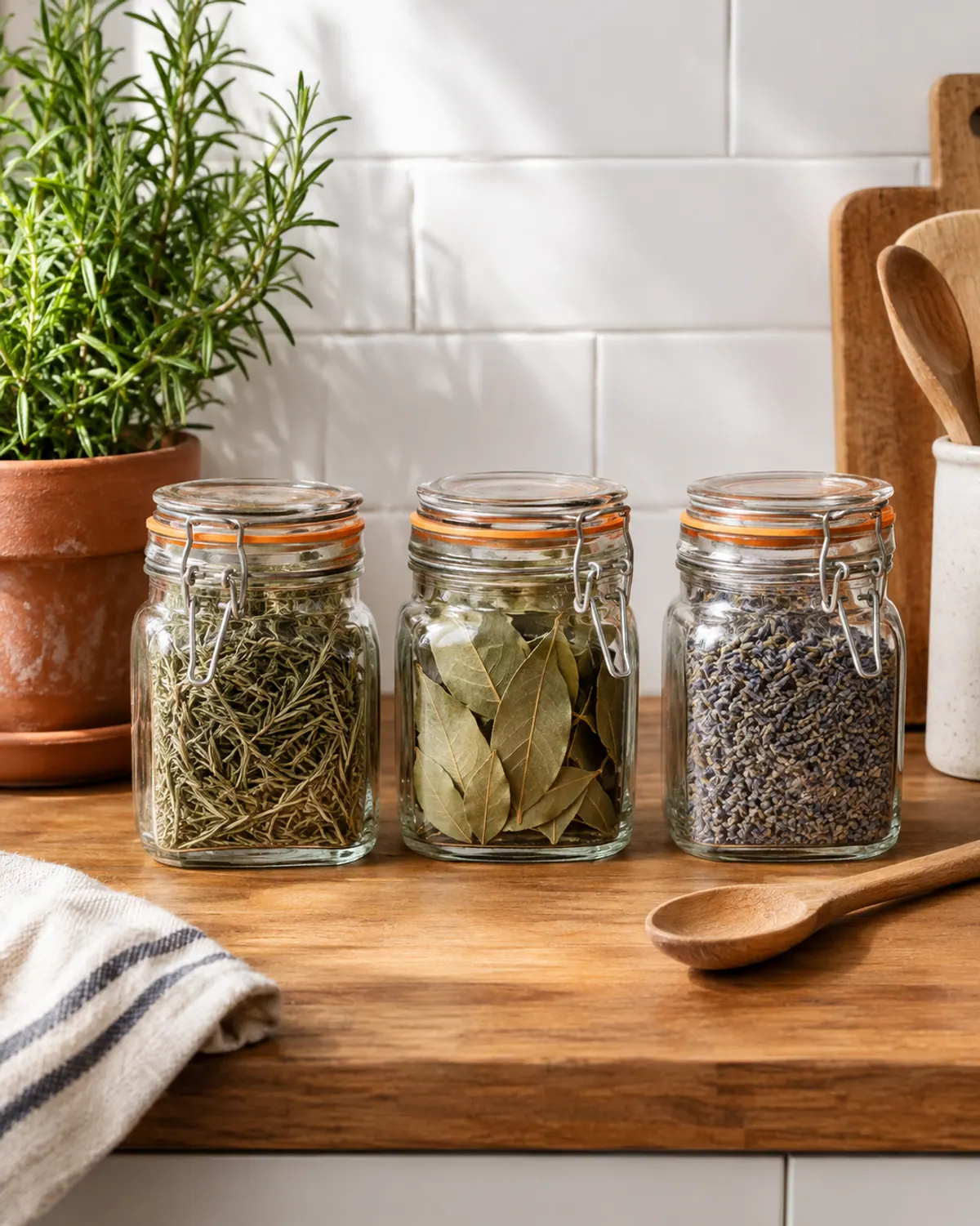
Light-proof: no. Airtight: yes, among the best. Counter-safe: only in a shaded corner. The wire clamp pulls the lid down onto a rubber gasket, so these seal tighter than most screw lids and open one-handed while you cook. Flavor: excellent in a cupboard; on a bright counter the clear glass still lets light do its work.
The square ones pack a cupboard better than round. Replace gaskets every couple of years when they stiffen.
- Check the gasket by closing the jar on a strip of paper; if it slides out easily, the seal is gone.
The tightest seal of any jar here; opens with one hand.
4Mini 2 oz jars for small batches
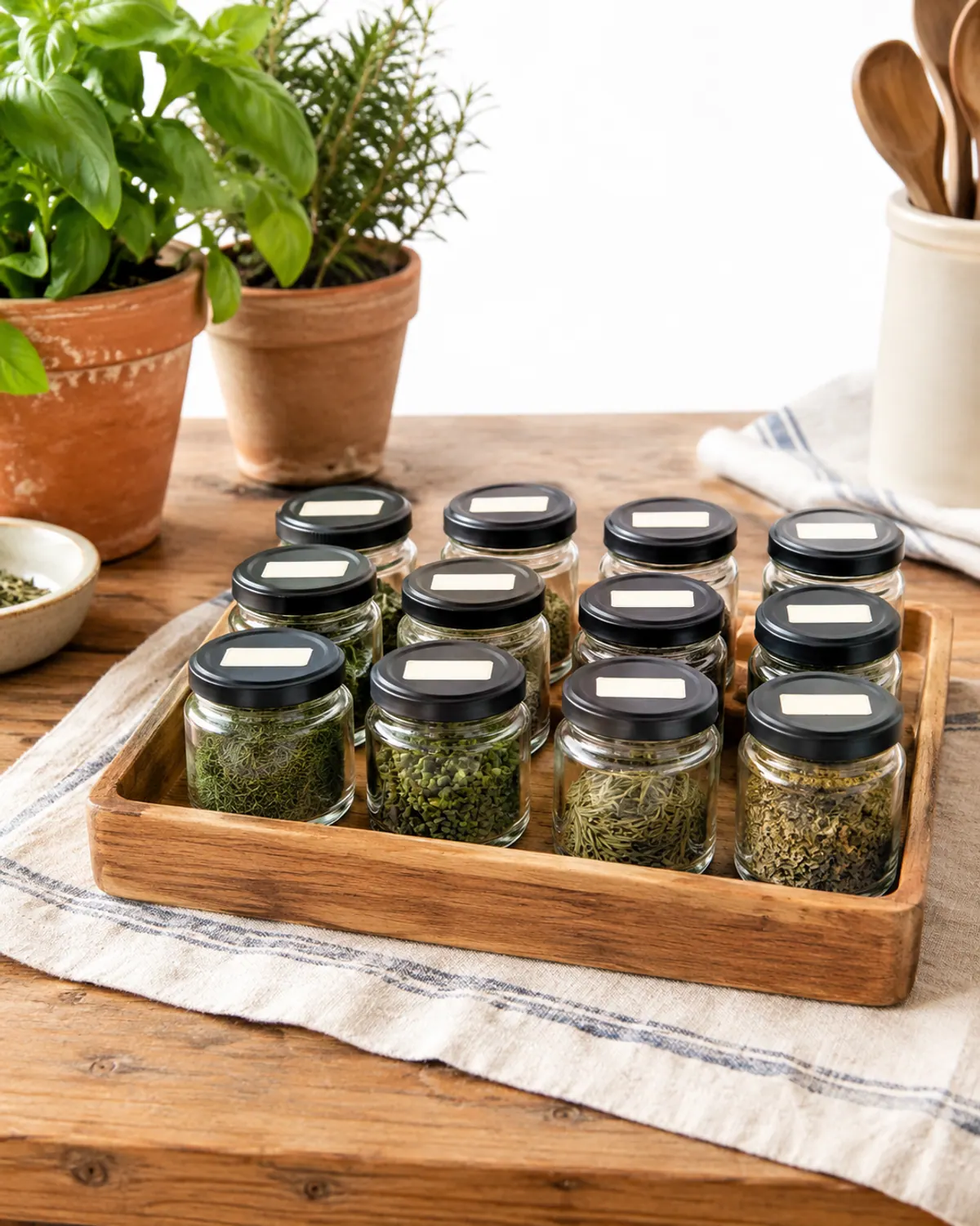
Light-proof: no. Airtight: yes. Counter-safe: no. A windowsill harvest of tarragon or chives may dry down to two tablespoons, and a half-empty jar is mostly air. Mini jars keep the headspace small, so there's less oxygen touching the leaves every time you open them. Flavor: better than a big jar for the same small batch.
They also suit herbs you only use a pinch of, and they fit the shallow drawer insert in idea 11.
- Fill small jars to the shoulder. Less air in the jar means slower fading.
Small headspace suits windowsill-sized harvests and one-pinch herbs.
5A working set of clear shaker jars in a drawer
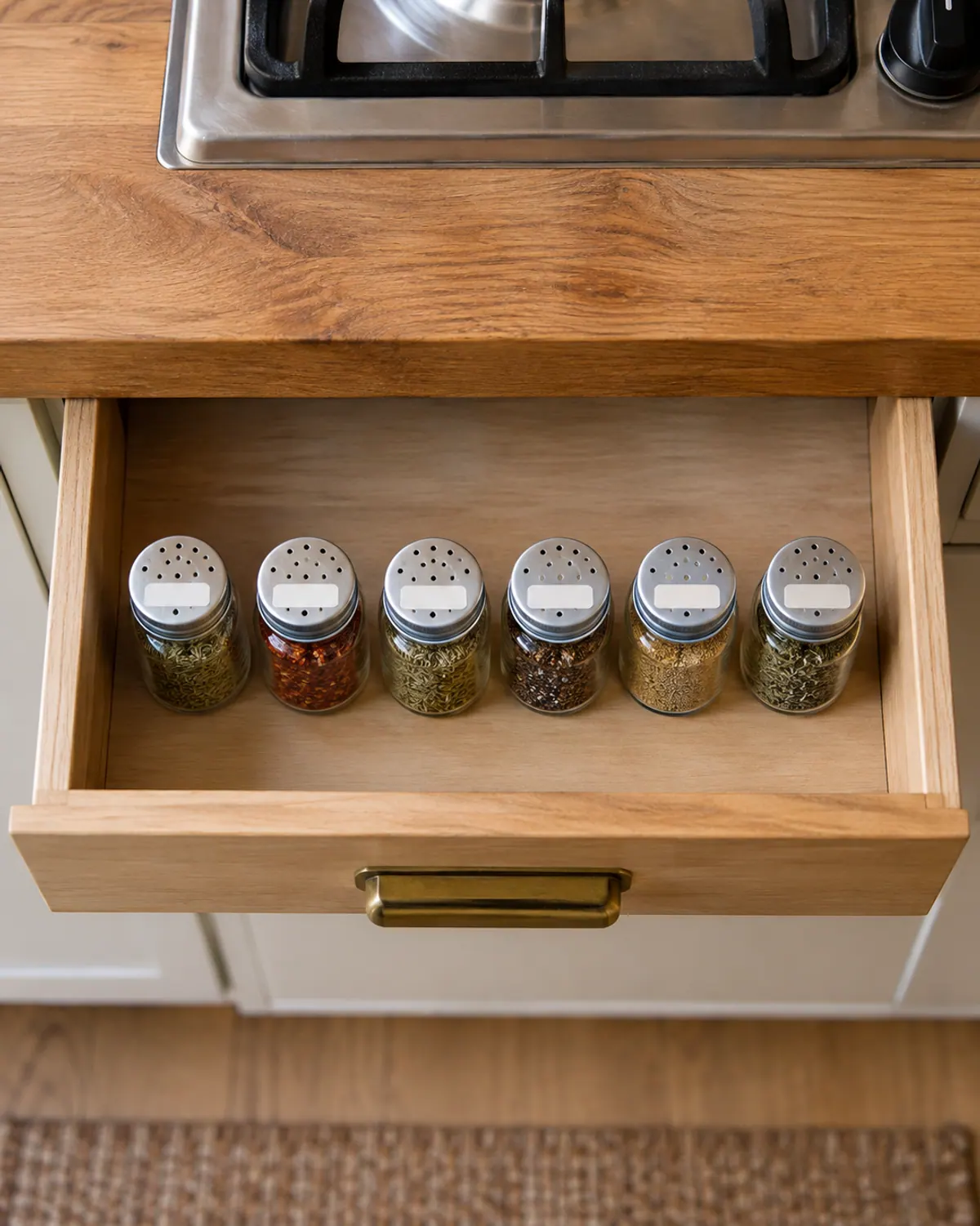
Light-proof: no (the drawer is). Airtight: no. Counter-safe: no. Shaker lids are leaky, so they shouldn't hold a year's supply. But a small set, refilled every few weeks from your sealed jars and kept in a drawer by the stove, is the easiest way to actually cook with what you dried. Flavor: the main jar stays full-strength; the working jar is used before it fades.
Think of it as a two-tier system: storage jars in the dark, cooking jars within reach.
- Refill working jars only to a quarter full; it keeps the supply moving.
Buy a set that includes solid lids too, so the same jar can be sealed later.
Dried herb storage containers that aren't jars
Glass is heavy, breakable and takes a shelf. When space is the problem, or the harvest is bigger than a jar, these four do the job.
6Metal tins with tight-fitting lids
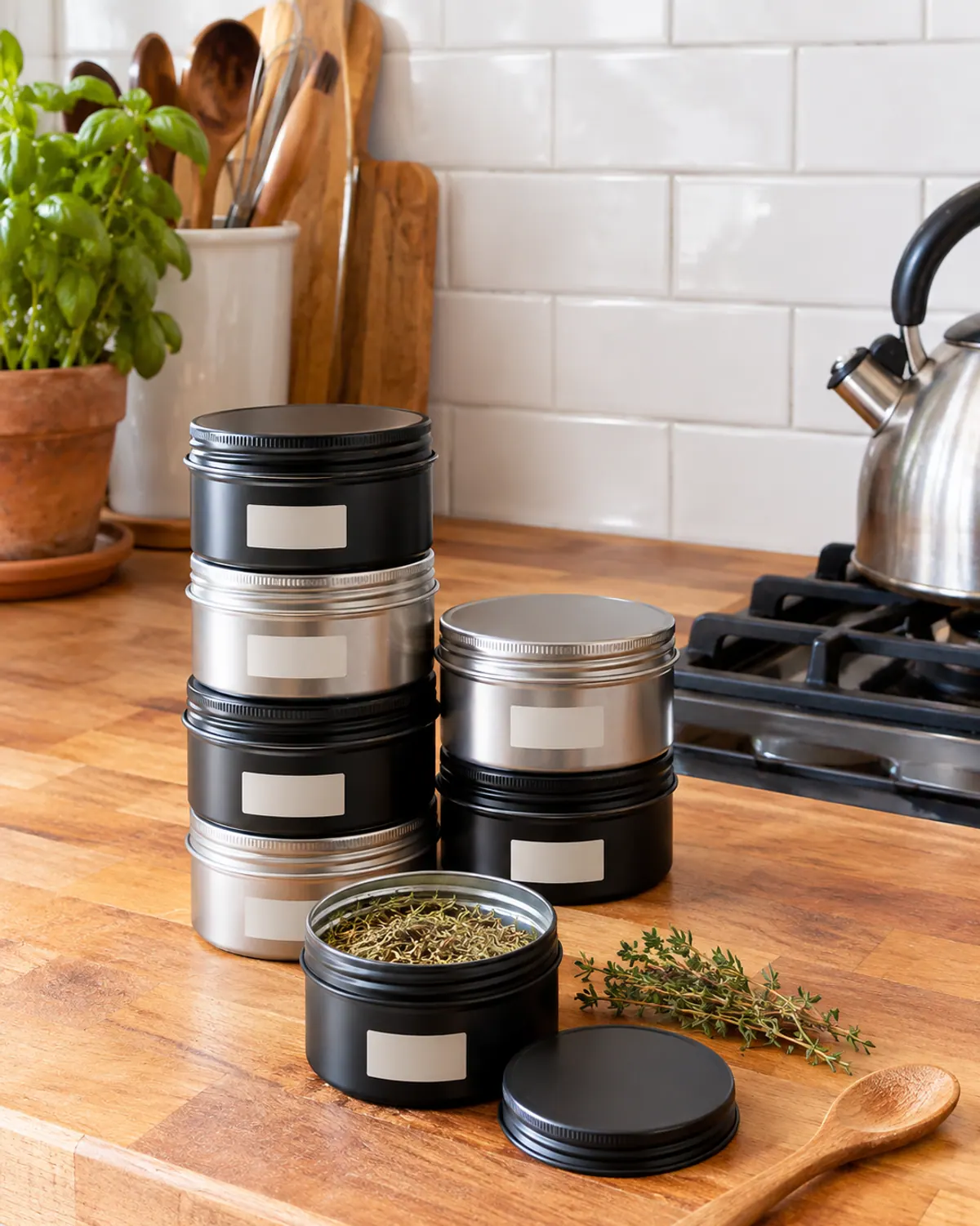
Light-proof: yes. Airtight: screw-lid and gasket tins yes, slip-lid tins no. Counter-safe: yes. Tins block every bit of light, weigh almost nothing and stack. The weak point is the lid: a slip lid leaks a little air, so use those for herbs you go through in a season, and choose screw or gasket lids for anything you want to keep a year. Flavor: screw-lid tins hold as well as amber glass; slip-lid tins are good for 6 to 12 months.
They're also the one container that can sit on the counter nearest the stove without the light problem, though heat still shortens their life.
- Stick-on labels on tins fall off in steam. Use a label maker tape or write on masking tape.
Fully light-proof and stackable; screw lids seal properly.
7Resealable mylar pouches for overflow
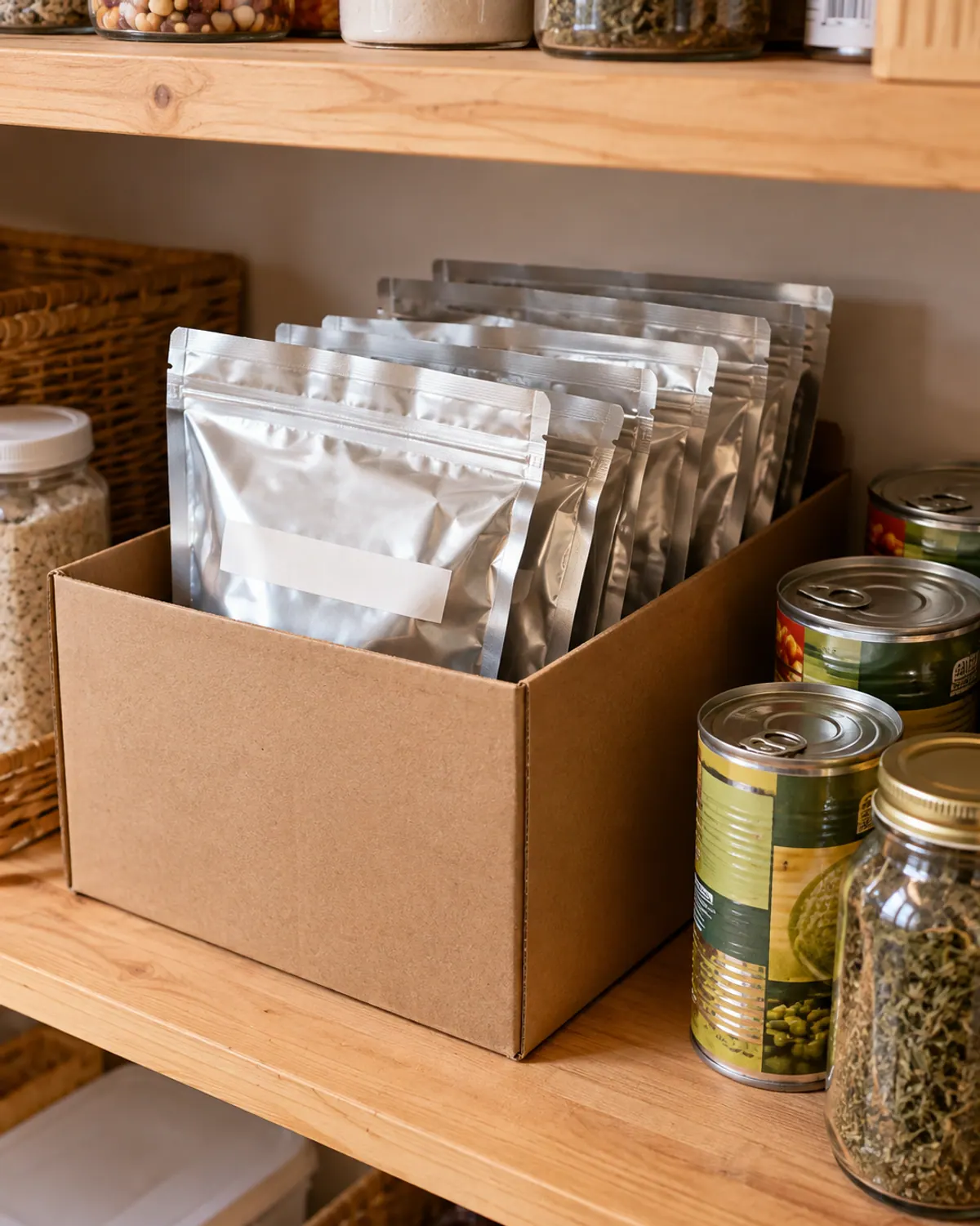
Light-proof: yes. Airtight: yes, when pressed flat. Counter-safe: yes, though they're not pretty. When the mint comes in by the armful, a pouch holds a whole plant's worth in a quarter of the space of jars. Press the air out before zipping and the leaves sit in near-vacuum. Flavor: among the best for long storage, because there's almost no headspace.
Keep pouches as the reserve and refill a jar from them. They stand up in a shoebox or file flat in a drawer.
- Buy pouches with a zip above a heat-seal line; you can heat-seal with a flat iron for a year's storage, then cut and zip.
Flat, dark and sealed; the best cheap answer to a big harvest.
8Vacuum-seal canister or vacuum lids
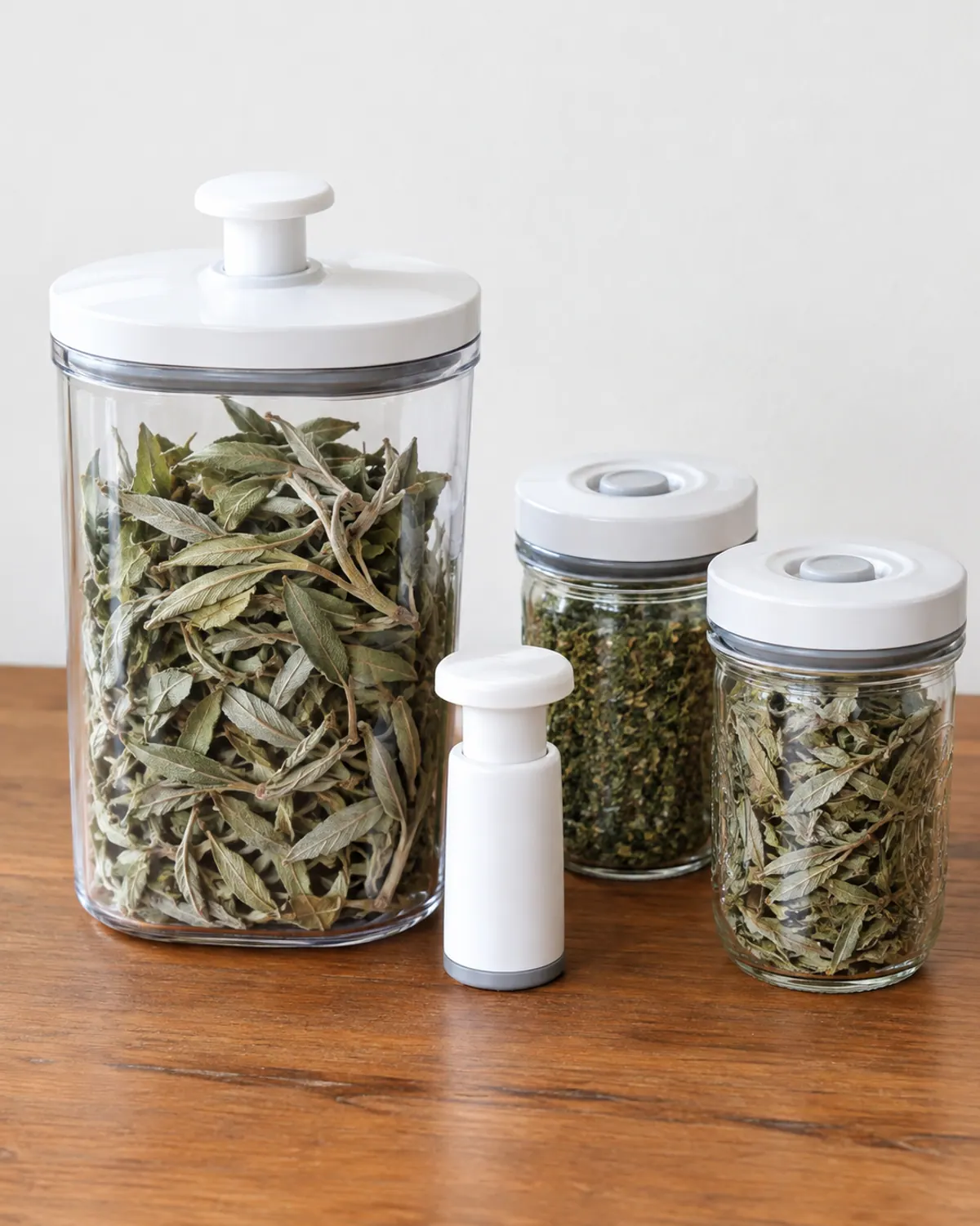
Light-proof: no. Airtight: yes, the most airtight here. Counter-safe: no. A hand pump pulls the air out of a canister or off a mason jar fitted with a vacuum lid, which takes oxidation almost out of the equation. Flavor: whole leaves and seeds keep aroma longest this way. It's overkill for a jar of thyme you'll finish by spring, and worth it for a year's worth of your best basil.
Pair it with a dark cupboard, since nearly all canisters are clear.
- Pump the jar again after every opening; the seal is only as good as the last pull.
Turns the jars you already own into the tightest storage on this list.
9A freezer jar for soft herbs and big batches
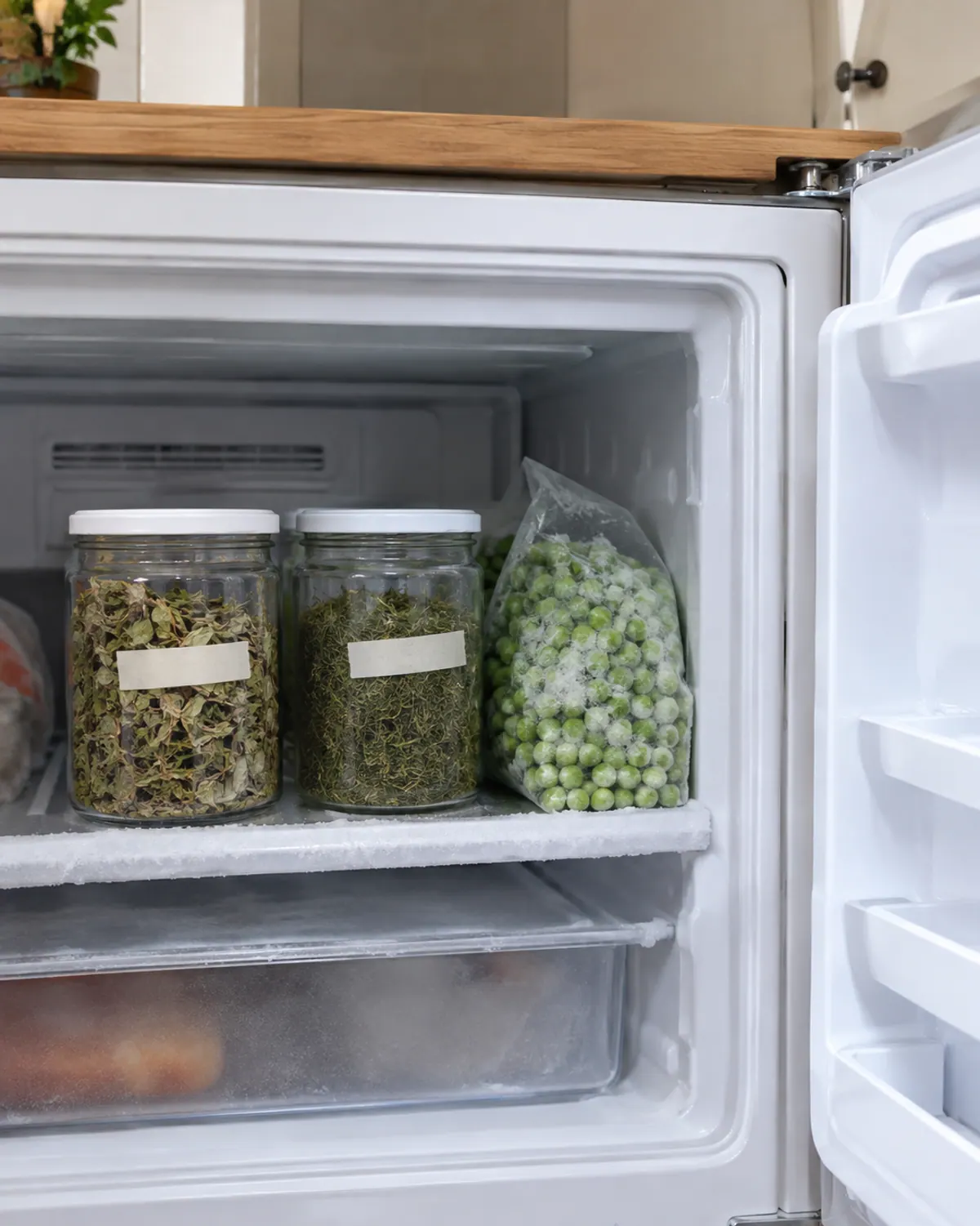
Light-proof: yes (freezer). Airtight: yes. Counter-safe: not applicable. Soft-leaf herbs like basil, dill, chives and parsley fade fastest in a cupboard. A straight-sided freezer-safe jar in the freezer slows that down a lot, and a big batch of anything keeps longer cold. Flavor: the best option for soft herbs beyond six months.
The catch is condensation. Take out what you need quickly and close the jar before it warms, or moisture collects on the leaves. Better: freeze the bulk and keep a small working jar in the cupboard.
- Leave an inch of headspace and use a straight-sided jar; shoulders crack when contents shift.
Straight sides and wide mouths handle freezing without cracking.
Racks, risers and drawer inserts for a tiny kitchen
Where jars go matters as much as the jars. The goal is dark, cool, and in reach, in a kitchen where every inch is already taken. These five ideas fit a cupboard, a drawer, a door or one short run of wall.
10Tiered riser inside a cupboard
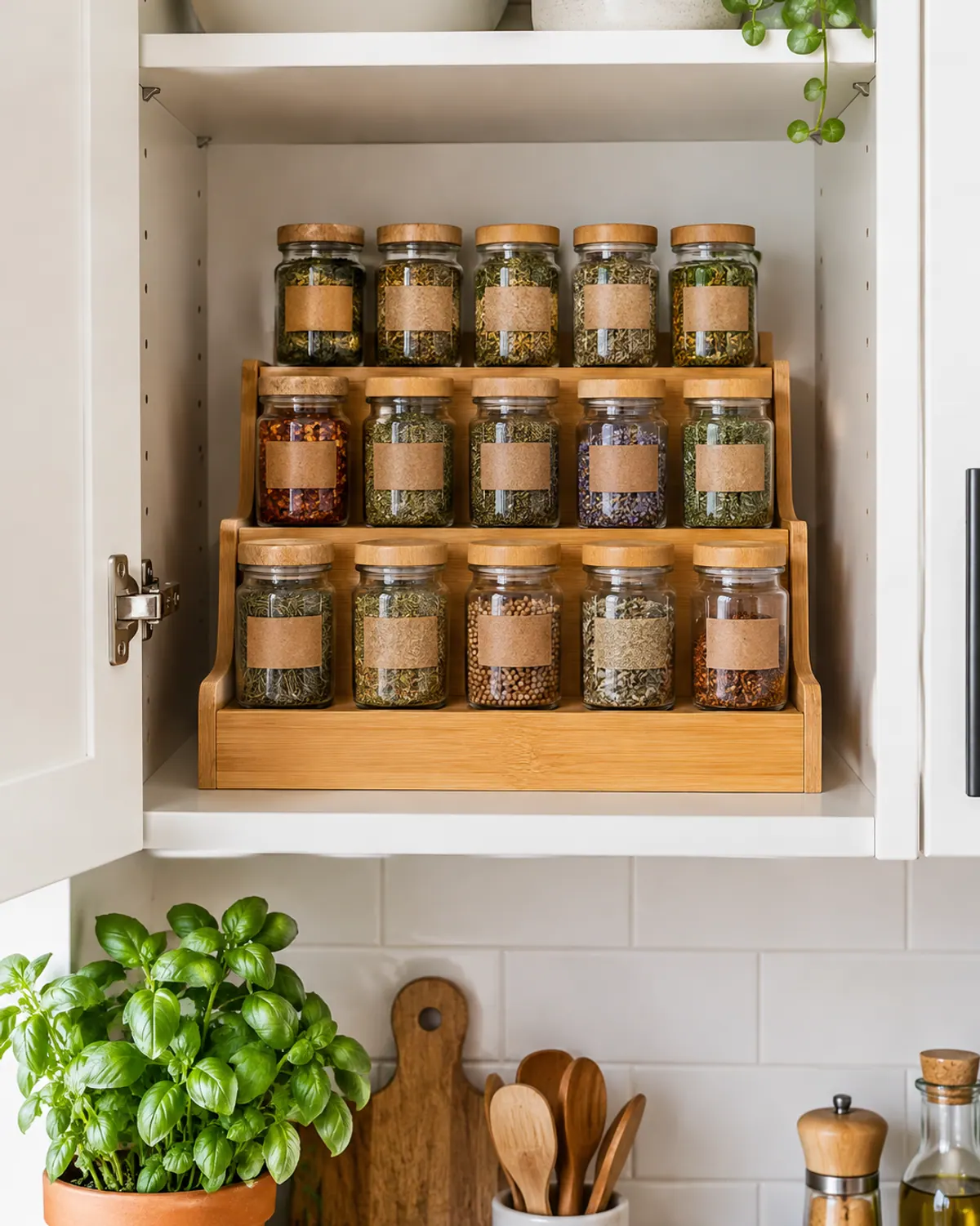
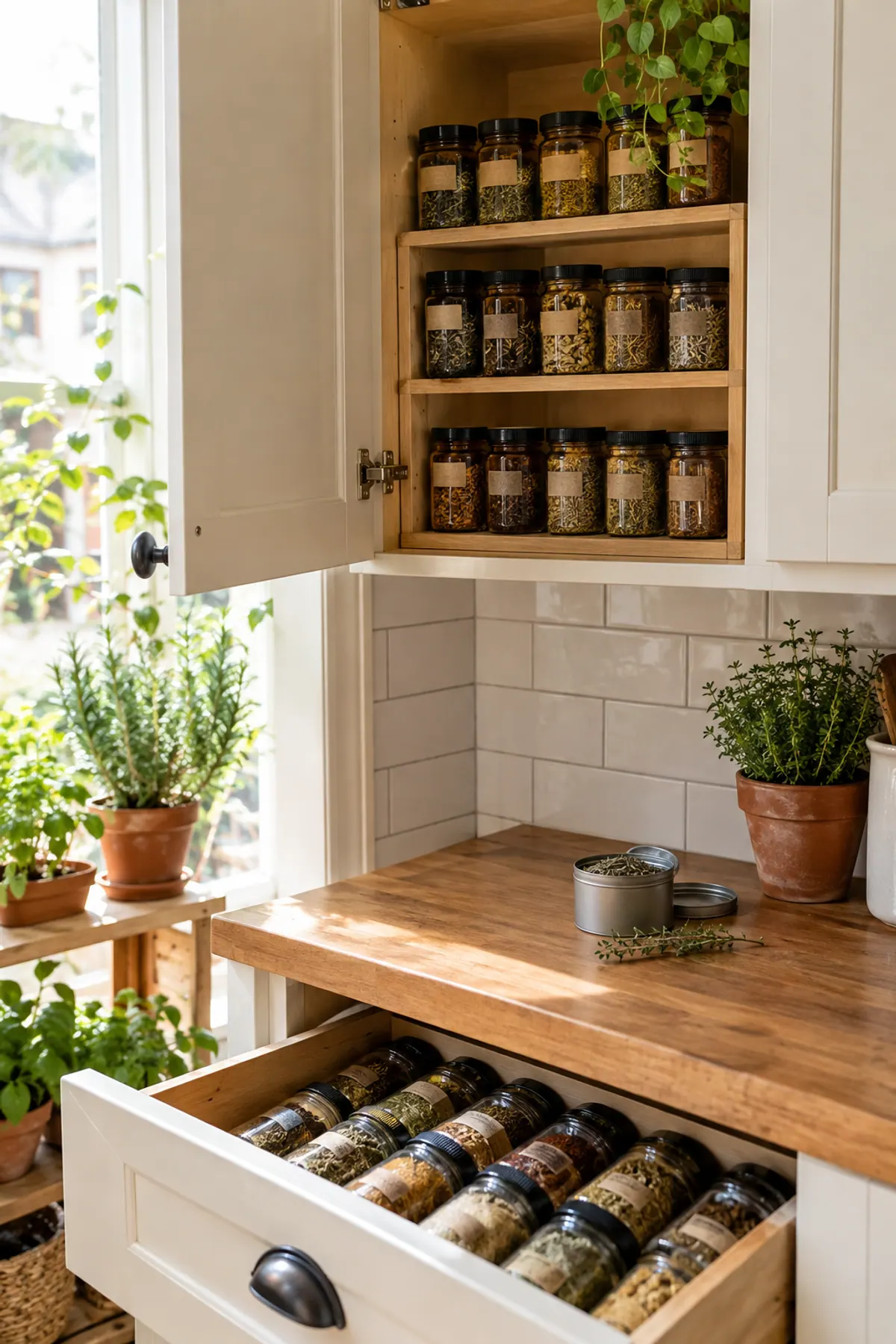
Light-proof: yes (door). Airtight: depends on the jars. Counter-safe: not needed. A stepped riser turns one cupboard shelf into three rows you can read at a glance, so you stop buying the fourth jar of oregano. Flavor: as good as the cupboard is dark and cool. Measure the shelf depth first; most risers are 8 to 9 inches deep.
Put the herbs you use most on the front step and the long-keepers (seeds, bay, rosemary) at the back.
- Expandable risers fit odd cupboard widths; fixed ones are sturdier for heavy glass.
Triples what you can see on one shelf behind a closed door.
11Drawer insert with jars lying flat
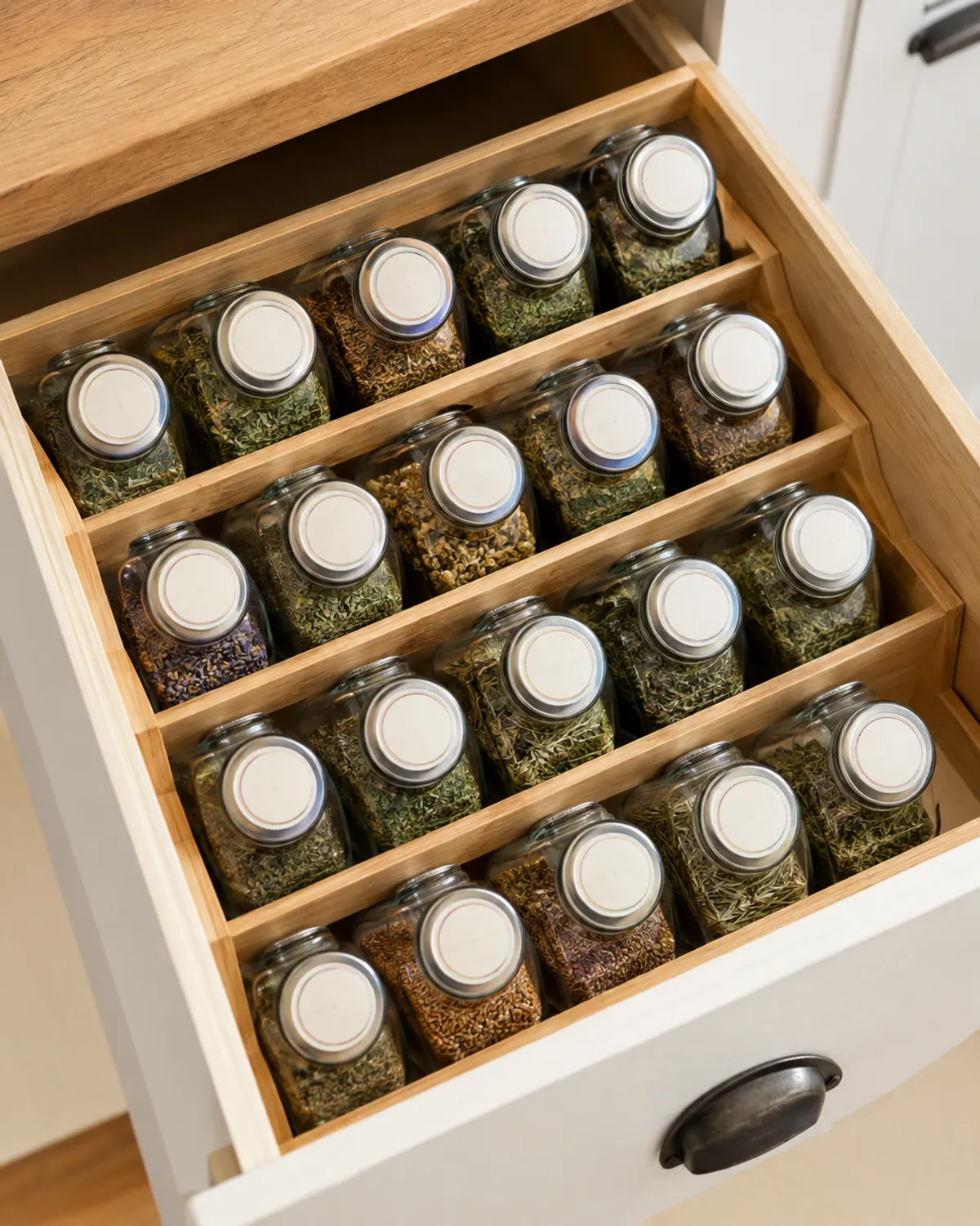
Light-proof: yes (drawer). Airtight: depends on the jars. Counter-safe: not needed. A drawer is the darkest, coolest spot most kitchens have, and a tilted insert lets you read every lid without lifting a jar. Flavor: the best everyday spot for clear glass. Use one standard jar size so the rows line up, and label lids, not sides.
This is where the mini jars (idea 4) and the working shaker jars (idea 5) belong.
- Choose the drawer farthest from the oven; the one beside it runs warm all winter.
Dark, cool and readable at a glance; fits a standard 3-inch-deep drawer.
12Narrow wall rack on an interior wall, away from the stove
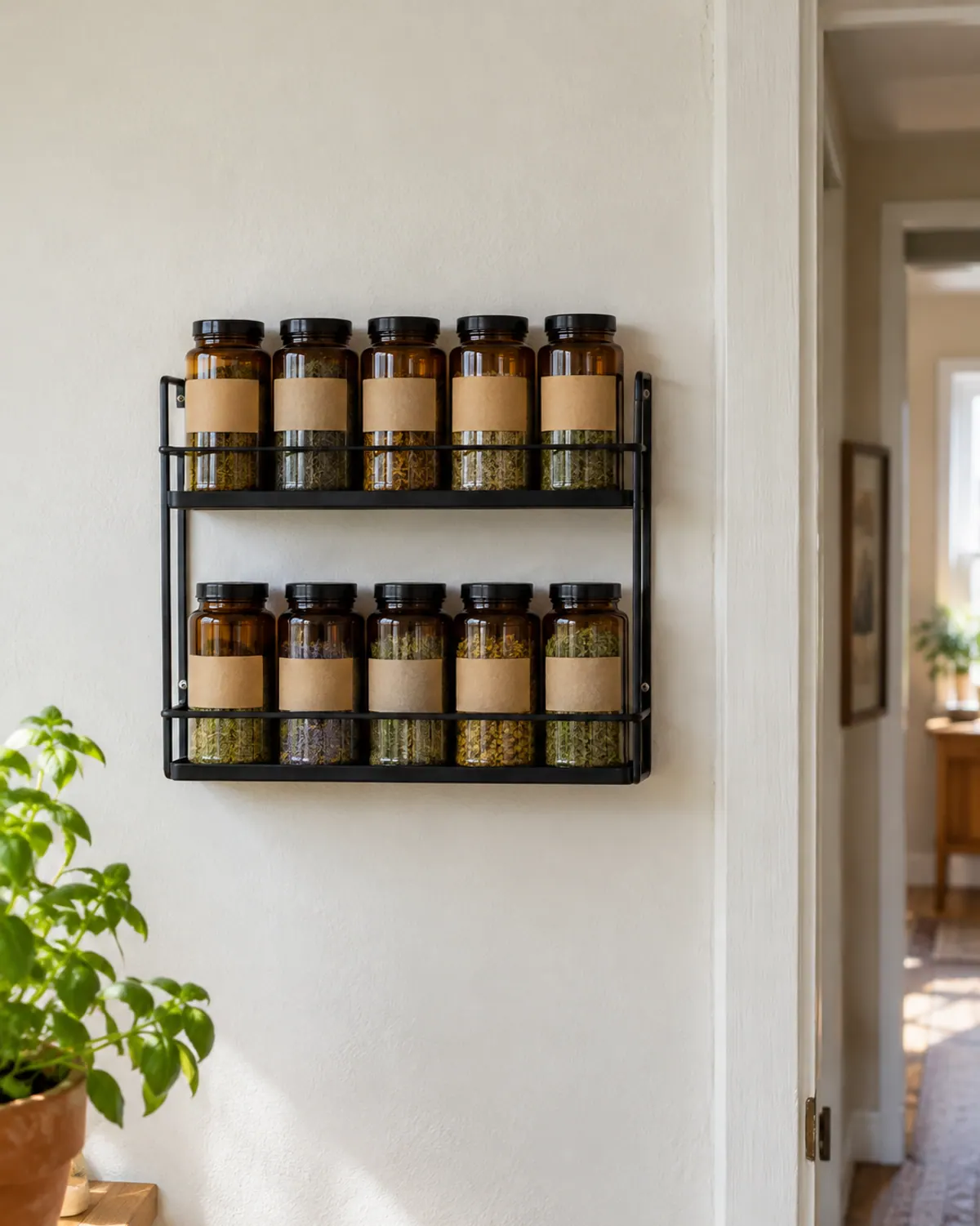
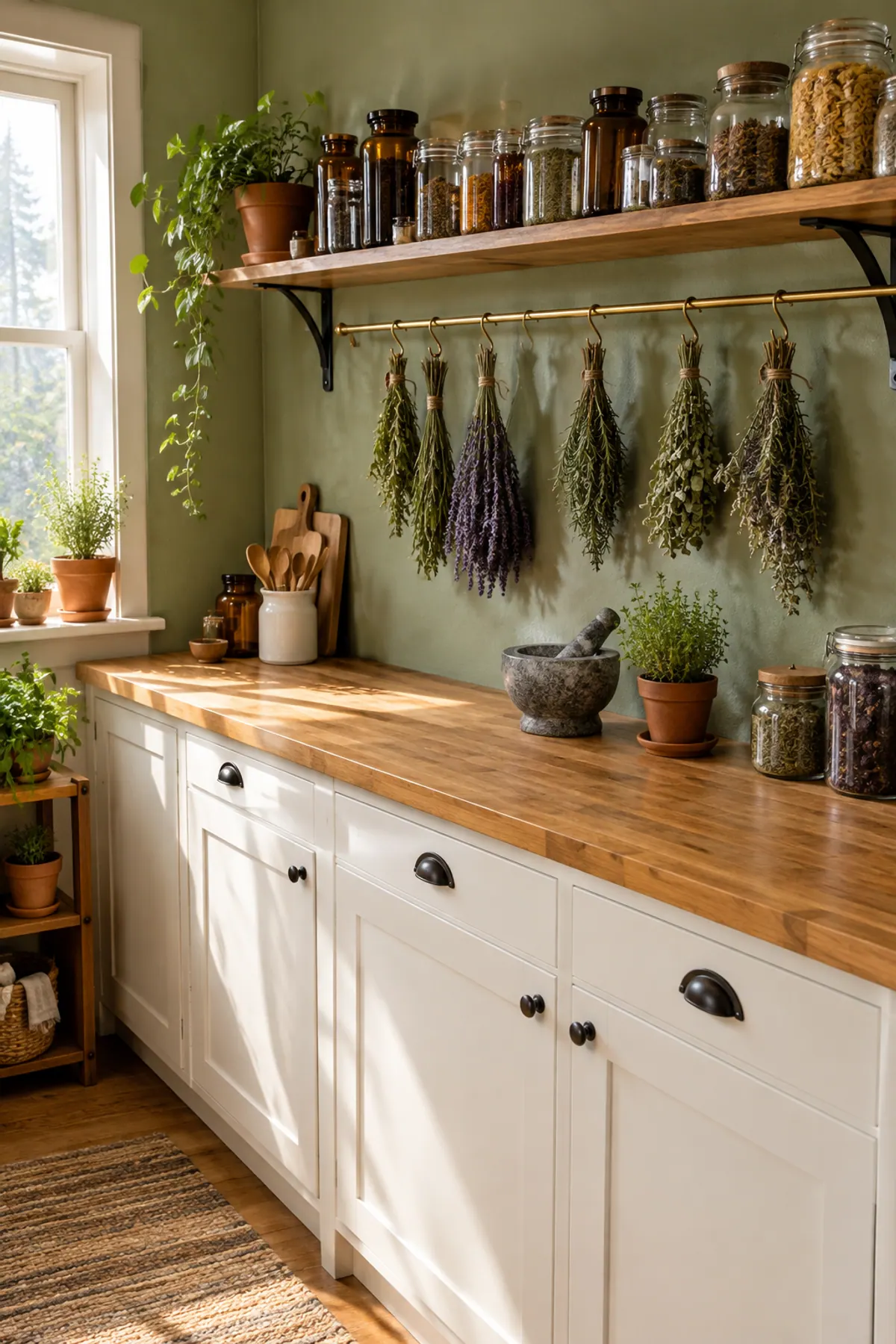
Light-proof: only with amber jars or tins. Airtight: depends on the jars. Counter-safe: yes, if placed right. A wall rack costs no counter or cupboard space at all. The rule is placement: an interior wall away from the window and at least a few feet from the stove, so the jars don't bake. Flavor: with amber glass or tins, nearly as good as a cupboard; with clear jars by a window, it's the worst spot in the kitchen.
Two shelves of 4 oz jars is about 16 herbs, which is more than most of us grow.
- Add a lip or a tension rod across the front if you have a cat who patrols the wall.
Zero counter space; pair with amber jars so it can live in the open.
13Over-the-door pantry rack
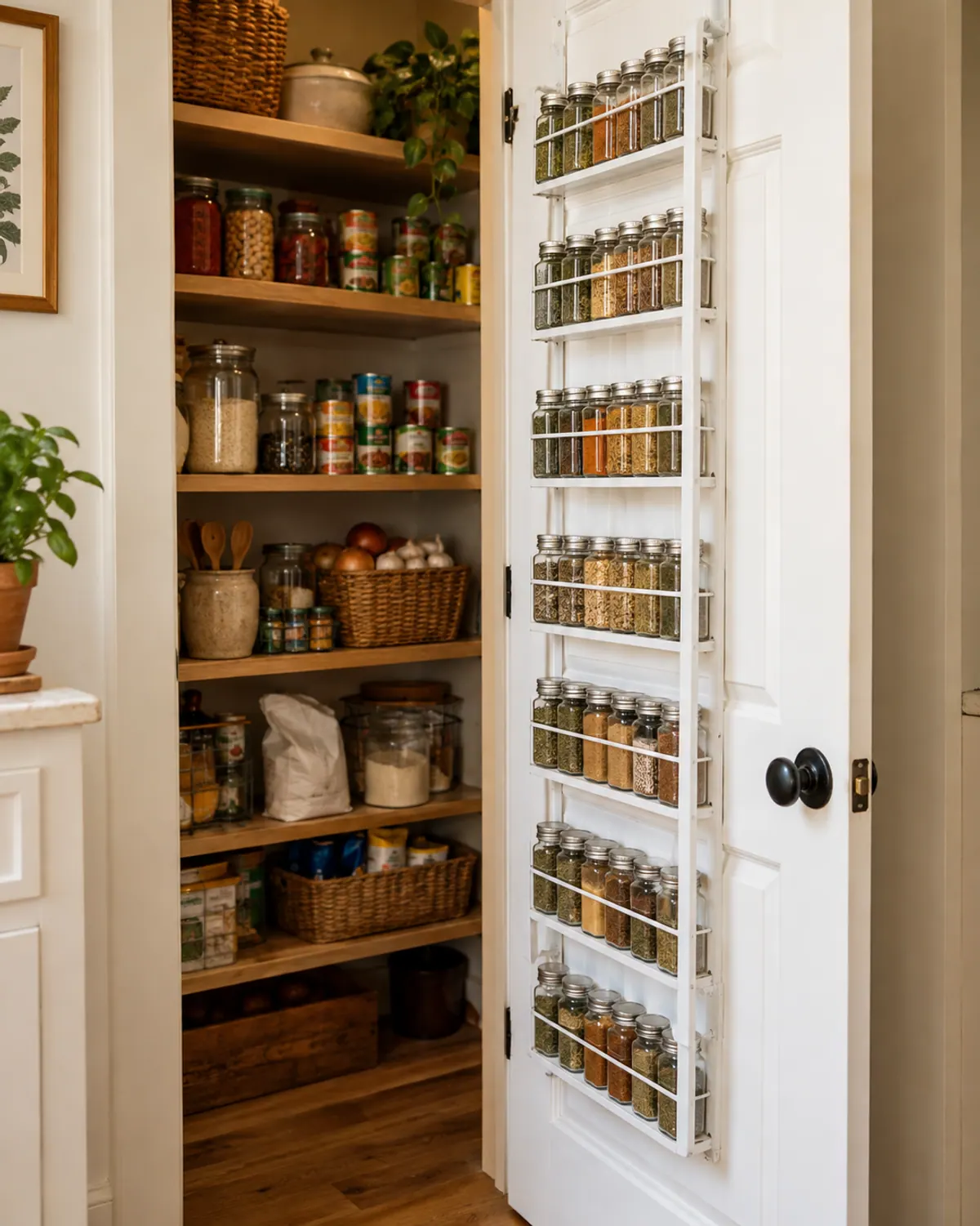
Light-proof: yes (door closed). Airtight: depends on the jars. Counter-safe: not needed. The inside of a pantry or closet door is unused, dark and usually cool. A shallow rack with 3-inch deep shelves holds small jars without hitting the pantry shelves when the door closes. Flavor: as good as a cupboard. Weigh the door; a hollow-core door and 40 glass jars make a rack that sags.
If you have no pantry, the back of a broom-closet door or a hall closet works the same way.
- Lips or rails on every shelf matter here; a slammed door launches jars.
Uses a dark surface nobody else wants; rails keep jars in place.
14Tabletop apothecary drawer cabinet
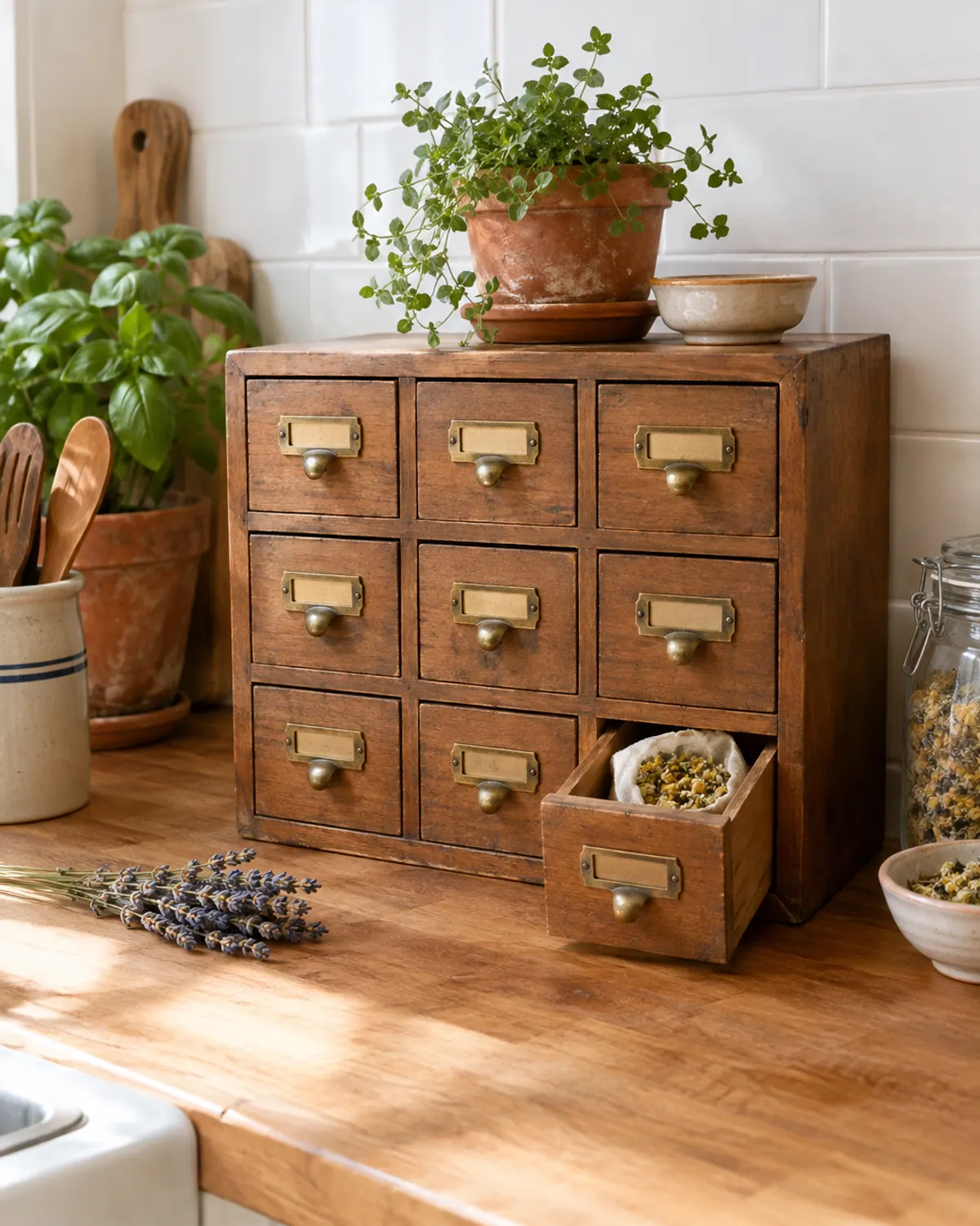
Light-proof: yes. Airtight: no, unless you bag inside the drawer. Counter-safe: yes. A little cabinet of drawers is the prettiest dark storage you can put on a counter, and the drawers are wooden, so they block light fully. The drawers are not sealed, which is the catch. Put each herb in a small zip pouch or a 2 oz jar inside its drawer and you get both. Flavor: with pouches inside, good for a year; loose in the drawer, a season.
We covered the decor side, with apothecary shelves and jar displays, in apothecary aesthetic kitchen ideas; this is the practical version.
- Line each drawer with parchment so the wood doesn't pick up oregano forever.
Light-proof and good-looking on a counter; add pouches inside for the seal.
Labels that work: name, date and whole or crushed
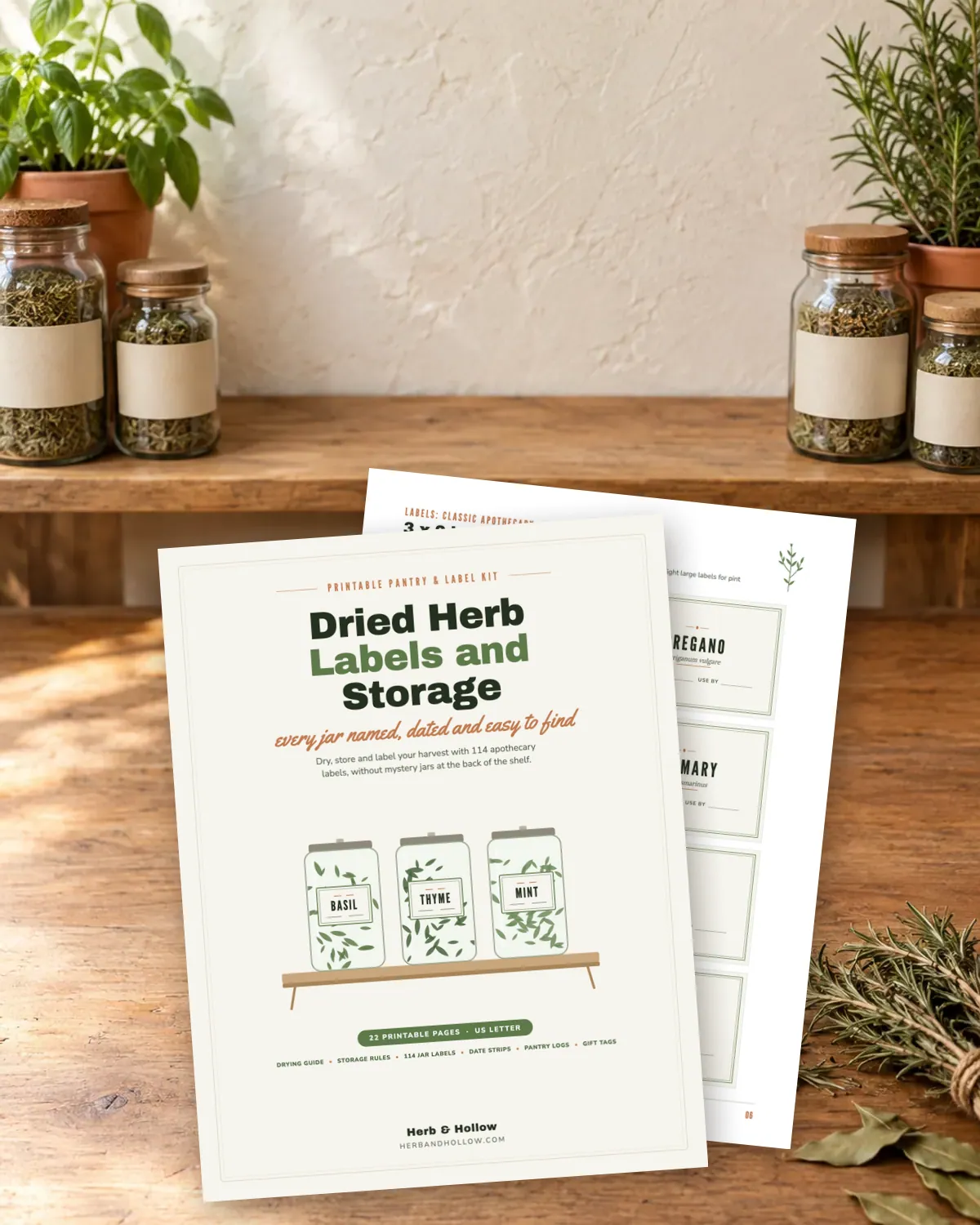
Dried marjoram and dried oregano look the same in a jar. So do mint and lemon balm in February. A label needs three things: the herb name, the month and year you dried it, and whether it's whole or crushed, since crushed herbs fade sooner and need using first.
15A label system: kraft labels on the front, dates on the lid
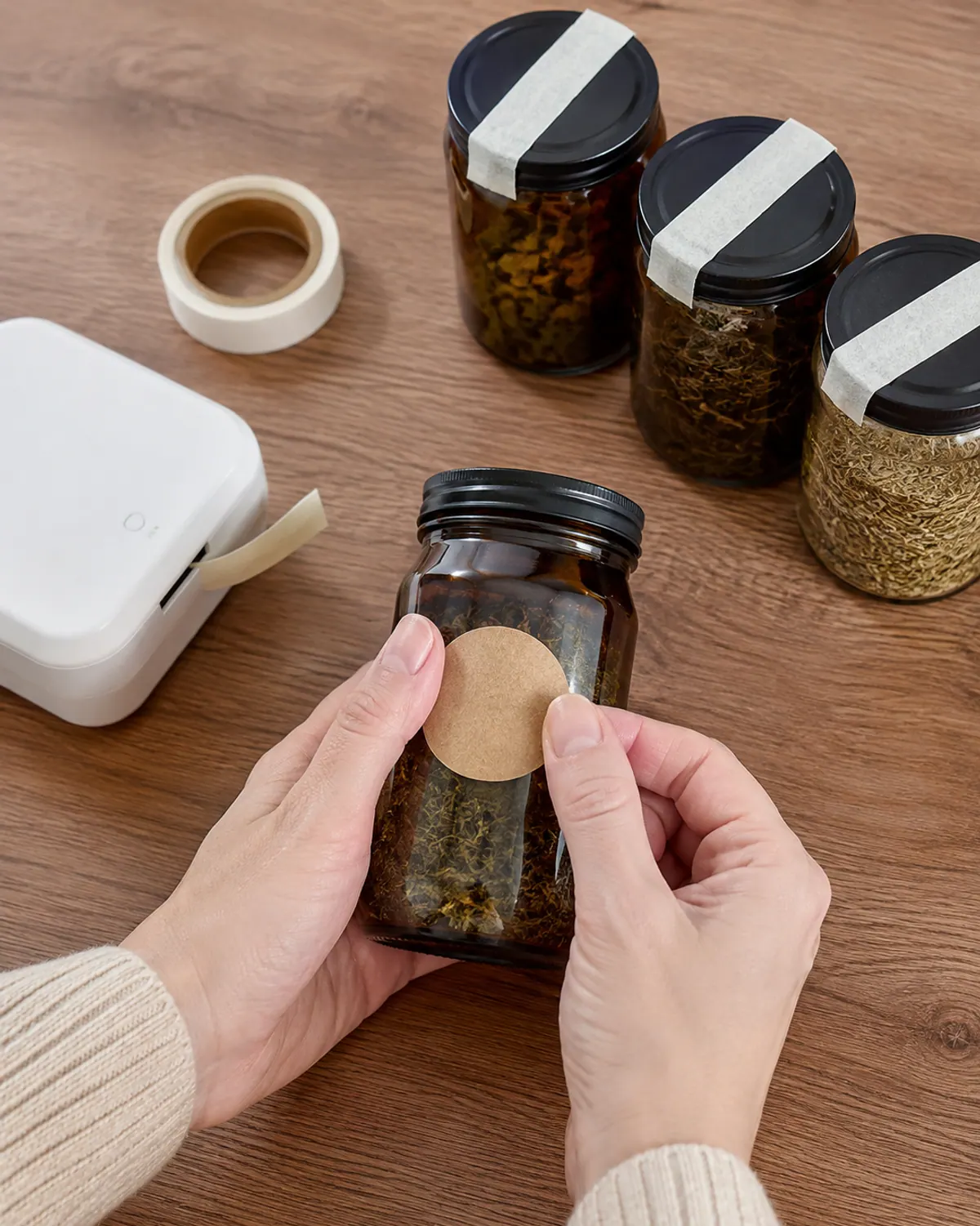
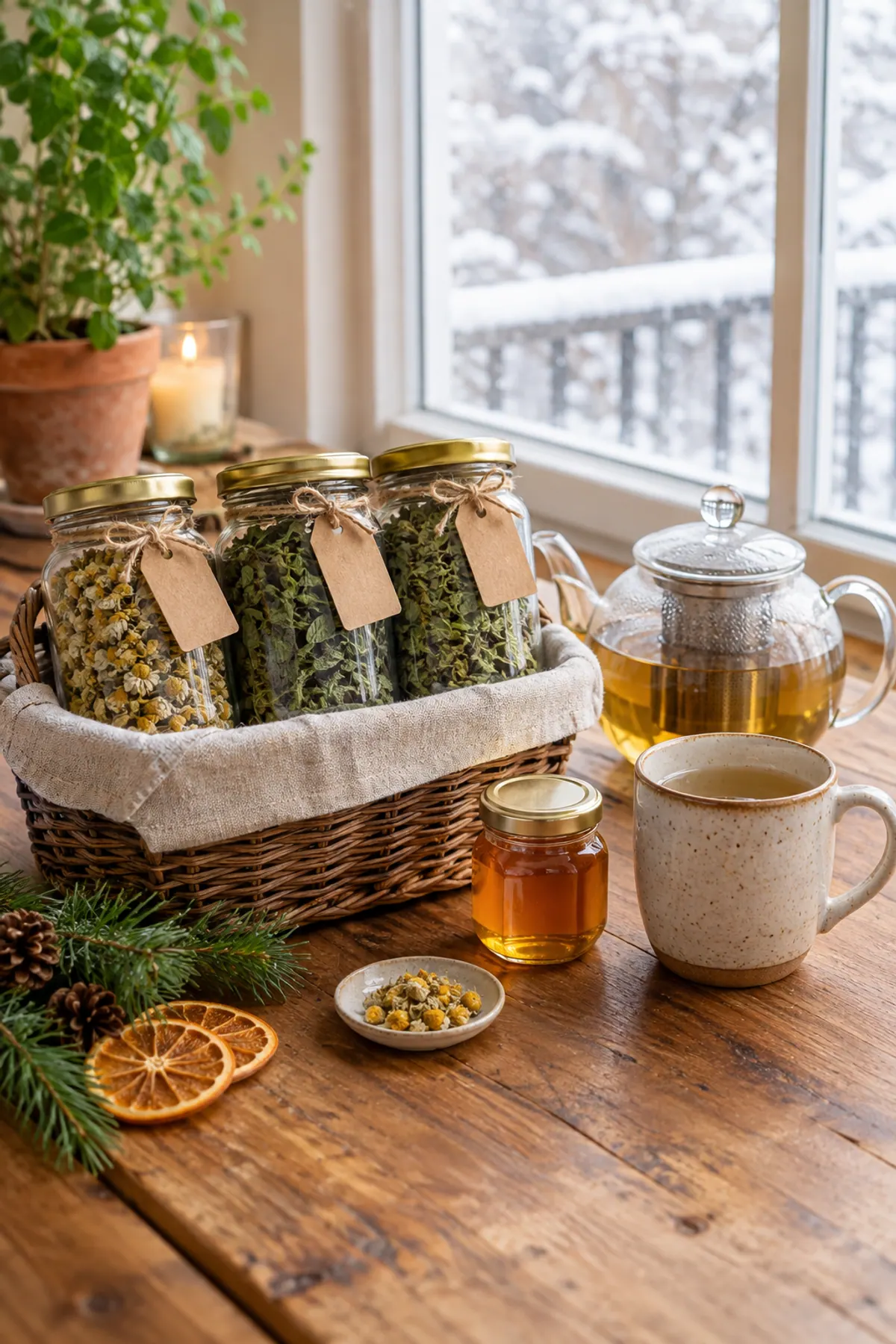
Light-proof and airtight: not applicable. Counter-safe: yes. Three styles that survive a kitchen. Preprinted kraft or black labels give you the herb name and look tidy; a label maker handles the odd herbs no preprinted set includes (lemon verbena, anise hyssop); and a strip of white tape on the lid takes the date in pen and peels off at refill. Flavor: none directly, but a dated jar gets used in order, and that's where flavor is saved.
Keep a jar inventory on one sheet: herb, date dried, whole or crushed, how many jars. The Herb Garden Journal includes a harvest and storage log laid out for exactly this.
- Write the date on the lid, not the jar: lids get swapped between jars far less than you'd think, and the lid is what you see in a drawer.
Covers the common herbs; add a label maker for the rest.
The Herb Garden Journal and Growing Cards ($7) has the harvest, drying and storage cards for 20 kitchen herbs plus a one-page jar inventory, so you know what you dried, when, and what to use first.
Where to put it all: dark cupboard, drawer or open shelf
Rank your kitchen's spots by the four enemies. A drawer far from the oven wins on all four. A cupboard that isn't above the stove or next to the dishwasher comes a close second. An open shelf is fine for amber glass and tins if it's out of direct sun and away from the range.
What we like
- You see and use what you dried, so nothing sits for three years
- Amber jars and tins hold flavor well even in the open
- No cupboard space lost in a kitchen that has none to spare
Keep in mind
- Clear jars fade within months on a sunny shelf
- Shelves above or beside the stove run warm and shorten every herb's life
- Steam and grease settle on jars near the cooktop and loosen labels
How long dried herbs last (leaves, seeds, roots, blends) and how to check
Dried herbs don't spoil the way fresh food does; they fade. The ranges below are for flavor in cooking, drawn from spice-trade and preserving guides that disagree with one another, so treat them as a window, not a date. The real test is in your hand: crush a pinch, smell it, and look at the color. Faint smell and grey-brown leaves mean it's time to compost and dry a fresh batch.
| Type | Examples | Keeps its flavor for about | Signs it's fading |
|---|---|---|---|
| Whole leaves, sturdy | Oregano, thyme, rosemary, sage, bay, marjoram | 1 to 3 years | Grey color, dusty smell |
| Whole leaves, soft | Basil, parsley, dill leaf, chives, tarragon, cilantro | 6 months to 1 year | Color goes from green to khaki; faint smell |
| Crushed or ground leaves | Any herb, once crushed | 6 months to 1 year | Smell gone when you rub it between fingers |
| Whole seeds | Coriander, dill seed, fennel, caraway | 2 to 4 years | No aroma when crushed |
| Flowers | Chamomile, calendula, lavender, mint flowers | 6 months to 1 year | Petals brown, scent flat |
| Roots and bark, dried sliced | Ginger, cinnamon stick | 2 to 4 years | Little smell when snapped |
| Blends | Herbes de Provence, Italian mix, tea blends | As short as the shortest ingredient, usually 6 months to 1 year | One note dominates; the rest has faded |
Dried herbs on this site are for cooking and flavor, not medicine, and nothing here is medical advice. If you dry herbs for tea, check anything you plan to drink regularly with your doctor if you're pregnant or nursing, and with your vet if a pet shares your kitchen. Our herbal safety page lists the common cautions.
Storing whole vs crushed, and freezing herbs you dried too late
Store leaves whole and crush them in your palm as you add them to the pan. Crushing breaks the cells that hold the oils; done in September, those oils have five months to escape before you cook with them in February. Done at the stove, they go into the food.
Dried too late in the season, or not quite dry? Leaves that bend instead of snapping still hold moisture and will mold in a sealed jar. Finish them for an hour in a dehydrator or a barely warm oven, or if you're out of time, freeze them in a pouch and call it done. Our drying guide covers the snap test and the three drying methods.
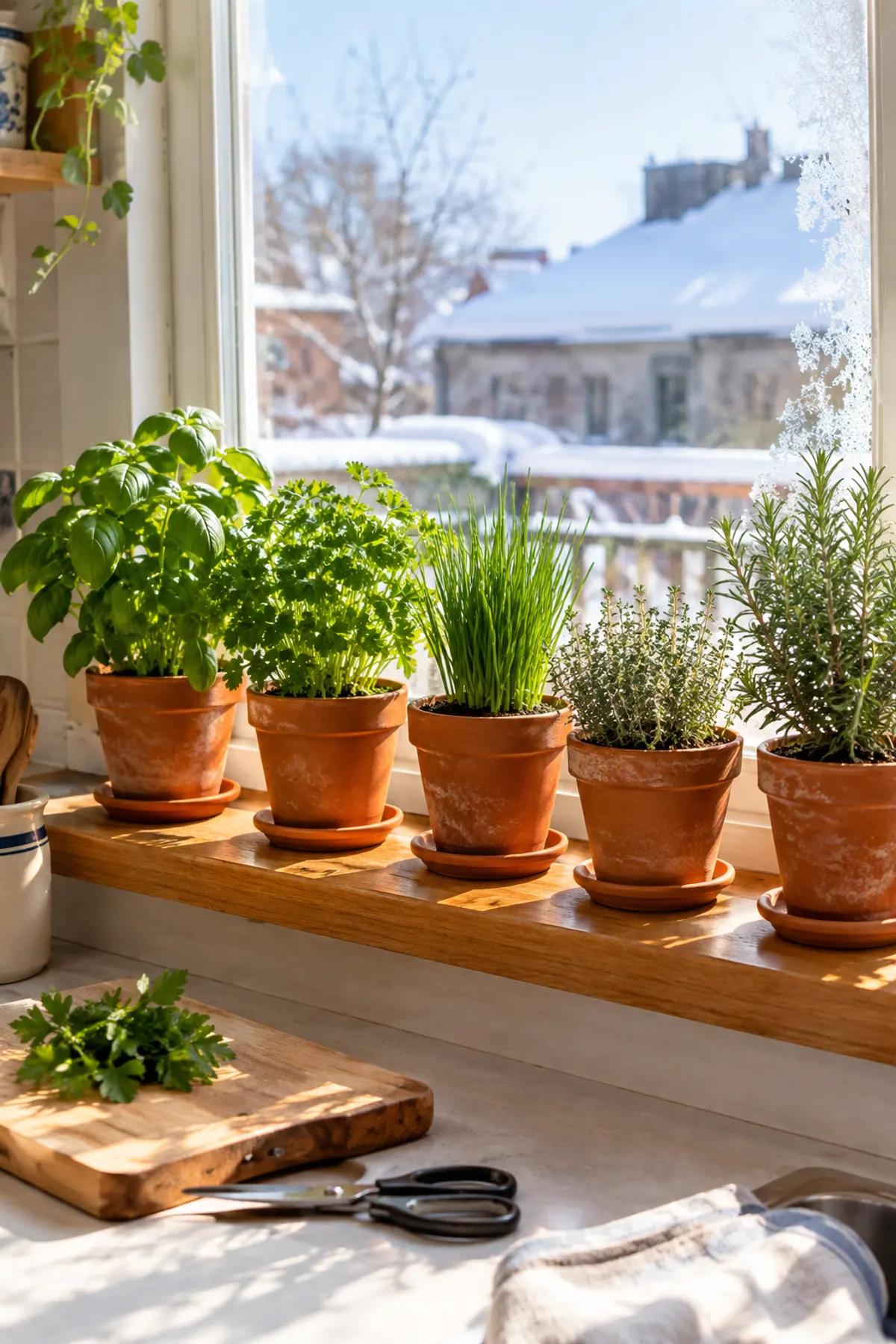
And for the soft herbs that never dry well (basil, chives, cilantro), the honest answer is to grow a fresh pot on the windowsill through winter instead. Our indoor herb garden guide covers which herbs manage in a window, and the Indoor Winter Herb Garden Kit ($6) lays out a sill or grow-light setup from first frost to spring.
Dried herb storage mistakes that waste a harvest
Seven mistakes to fix before you jar the next batch
One more: a stem or two that's still green in a jar of otherwise dry leaves is enough to spoil the lot. Strip leaves from stems and give any thick pieces an extra day.
A small-kitchen dried herb storage starter list
If you're starting from zero, this covers a year's worth of windowsill and balcony herbs for about $50 to $80. Prices are typical ranges and move around; we haven't tested these by hand.
Dried herb storage starter list
- Start here
Amber glass spice jars, 4 oz, 12 to 24 pack with labels
Typically $18 to $35
The main storage; works in a cupboard or out on a shelf.
Check price on Amazon for Amber glass spice jars, 4 oz, 12 to 24 pack with labels -
Mylar zip bags, 1 quart, with oxygen absorbers
Typically $12 to $25 for 50
Overflow and big harvests, flat in a drawer.
Check price on Amazon for Mylar zip bags, 1 quart, with oxygen absorbers -
In-drawer spice organizer or 3-tier cabinet riser
Typically $12 to $30
Puts every label where you can read it in the dark.
Check price on Amazon for In-drawer spice organizer or 3-tier cabinet riser -
Preprinted herb labels plus a roll of white tape for dates
Typically $8 to $15
Name on the front, date on the lid.
Check price on Amazon for Preprinted herb labels plus a roll of white tape for dates -
Silica gel desiccant packets, food-safe
Typically $6 to $12
One per jar in a humid kitchen; cheap insurance against mold.
Check price on Amazon for Silica gel desiccant packets, food-safe
Skip, for now: the 48-jar carousel, the magnetic fridge tins (warm, bright, and the fridge door is the one spot that's both) and anything sold as a drying rack and storage in one. Dry first, then store; the two jobs want different tools.
Frequently asked questions
How do you store dried herbs so they keep their flavor?
Whole, not crushed, in an airtight glass jar or screw-lid tin, somewhere dark and cool: a drawer or a cupboard away from the stove. Amber jars or tins can sit on an open shelf out of direct sun. Crush the leaves as you cook, not before you store them.
Should dried herbs be stored in glass or plastic?
Glass or metal. Plastic takes on smells, scratches and lets a little air through over time. The one useful plastic is a thick mylar zip pouch for overflow, which is sealed, dark and lies flat in a drawer.
Do amber jars really keep herbs fresher than clear jars?
On an open shelf, yes: amber glass filters most of the UV light that fades color and aroma. Inside a closed cupboard or drawer there's no light to block, so a clear jar does just as well. Buy amber for jars that live in the open and clear for the ones behind a door.
How long do dried herbs last?
For cooking flavor, sturdy whole leaves like oregano, thyme and rosemary keep about 1 to 3 years; soft leaves like basil and parsley about 6 months to a year; whole seeds 2 to 4 years; crushed or ground herbs about 6 months to a year. These are ranges, not dates. Crush a pinch and smell it: faint smell and grey color mean it's done.
Should you crush dried herbs before storing them?
No. Crushing breaks the cells that hold the aromatic oils, and those oils then fade in the jar over months. Store leaves whole and crush them in your palm as they go into the pan.
Can you keep dried herbs on an open spice rack near the stove?
It's the worst spot in the kitchen: heat, steam and light all at once. If it's your only wall, use screw-lid metal tins there as a working set, refill them monthly from sealed jars kept somewhere cool, and expect the tins' contents to fade in a season.
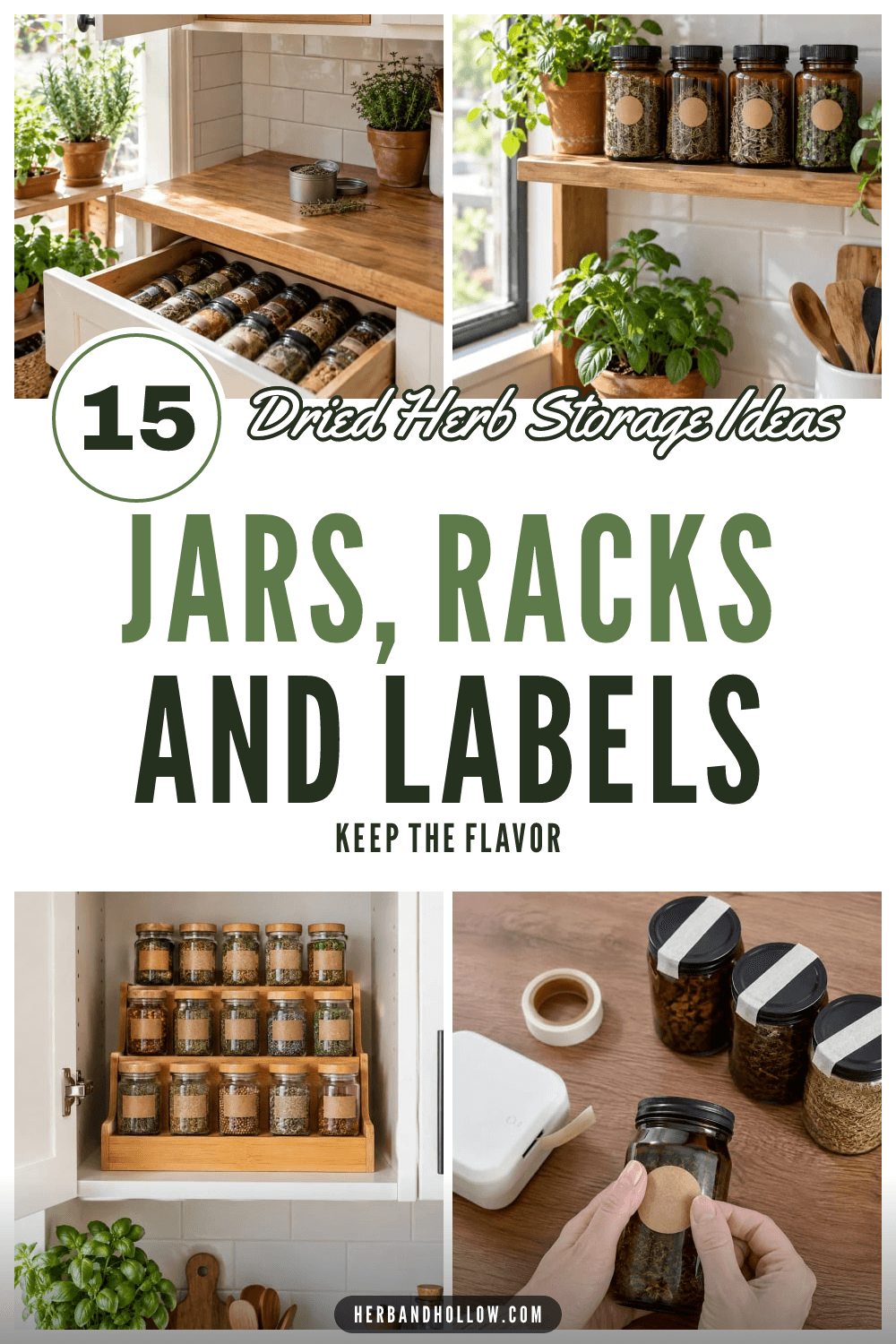
Save it for later
Pin this to your Kitchen Apothecary board so it's there when you need it.
Save to Pinterest